Newman realized that reason was needed in the act of faith, as belief in anything involves an intellectual assent to truth.
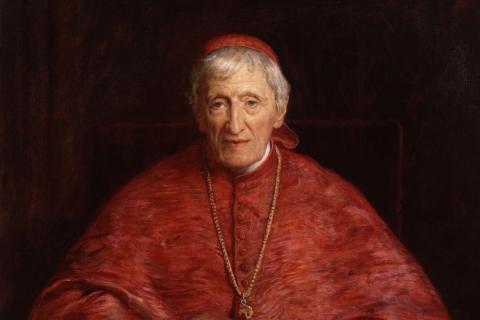
John Henry Newman, recently declared a Doctor of the Church by Pope Leo, lived in the 19th century at a time in which growing influences impacted the way many understood the relationship of faith and reason. Newman recognized the impact that English Romanticism had on believers, as writers and poets promoted greater subjective experience, sentimentality, and a search for beauty beyond what can be empirically known. He also recognized the threat of rationalism, in which many reduced certain knowledge to that which could be logically held or scientifically proven by the light of one’s own mind.
In this environment, Newman realized that reason was needed in the act of faith, as belief in anything involves an intellectual assent to truth. His formidable intellect was well-adapted at seeking out sound reasonings for his Christian belief, having studied the foundations of Anglicanism and later of Roman Catholicism. Yet at the same time, Newman also knew that faith in God cannot be reduced to an equation or a scientific experiment, as the reasoning mind in religious belief operates on different principles.
Reason plays an important role when considering deep questions about the existence of God and the meaning of life. The mind might consider questions such as, “Where did I come from? Is there a creator that is responsible for the world around me? Do I believe that there is a God who provides life beyond death? Where does my sense of right and wrong come from, and does this point toward an eternal standard of justice that is ordered by a Moral Governor known through my conscience?” These questions involve rational inquiry, in which satisfactory answers help to support one’s act of faith in God. Yet this rational exploration also has its limits, for while philosophical questions can lead one toward understanding the necessity of a Creator, the answers they generate could be held in a superficial manner, and such answers do not guarantee access to the living God who has revealed Himself in history.
Of primary concern for Newman was that true faith is ordered toward that which is real. He recognized that we often hold many notional concepts that can seem abstract and theoretical, or of an array of opinions and presumptions that lack solid evidence for support. Even religious people might profess belief in God that is theoretical and not rooted in a lived experience. Yet a true act of faith must be grounded in things that have left an impression on the imagination and that stirs one to action.
To appropriate a real apprehension of God, one must move beyond calculations and allow the imagination to apprehend an understanding beyond a notional concept. The impression that one holds of God through the imagination is gained not by equations, but by personal encounters with facts, events, and the testimony of witnesses within history. As Newman noted, “Persons influence us, voices melt us, looks subdue us, deeds inflame us. Many a man will live and die upon a dogma: no man will be a martyr for a conclusion.” With an inner stirring that is grounded in a real apprehension of God, the mind is able to offer an assent with a firm commitment. To simply remain with conclusions of rational inquiry does not give one an act of faith that is unconditional, nor allow one to enjoy a relationship with the living Lord.
In the apprehension of God, a believer does not blindly assent to that which has no intelligibility. The mind is deeply involved in the act of faith, yet this act is not confined merely to inferential reasoning, but involves the full faculties of the intellect in which images of beauty, the testimony of believers, and the acceptance of history are appropriated and ordered toward an assent to truth.
Newman understood that faith is not opposed to reason. Faith requires the intellect to act with care, to draw out a deeper understanding of the nature of God and his work in Revelation, and to appreciate the relationship that is established with Him. In this, the fullness of the mind’s sensibilities are utilized, which allow one to commit in faithful trust to a Person and not a mere conclusion. When committing to God, the mind rests assure that it apprehends that which is real, and appropriates a convergence of many reasons that ground the act of faith, beyond what any logical equation could provide. In this regard, faith and reason became two important elements that give us access to the God of Scripture and the God of Creation.